

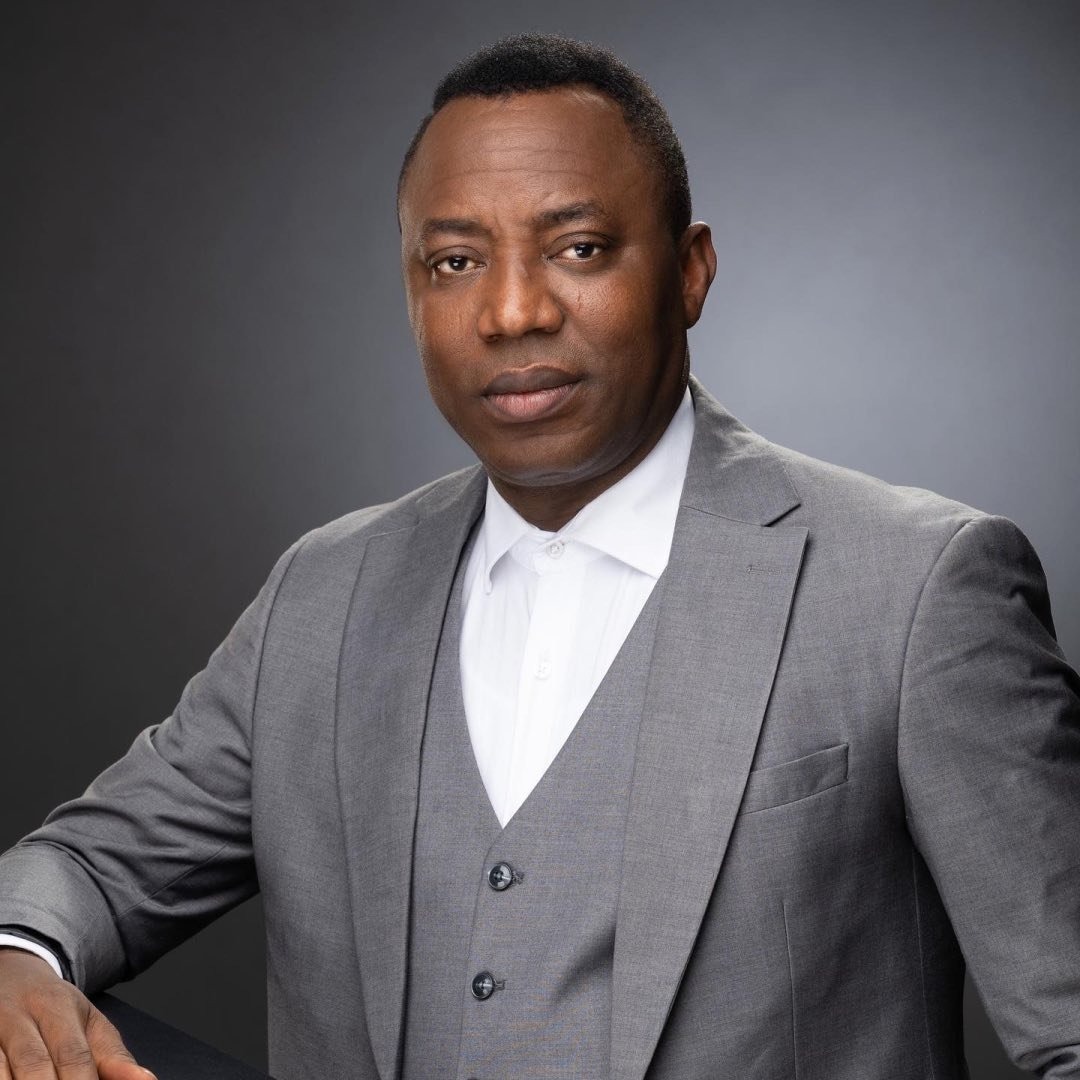

Sowore Defends “No-Case Submission” Insists Charges Are Baseless And Politically Motivated
Human rights activist and former presidential candidate, African Action Congress, AAC, Omoyele Sowore, has stated that the legal proceedings instituted against him by the Federal Government are without merit, maintaining that his legal team has filed a no-case submission and is awaiting the court’s ruling on the matter.
Addressing a wide range of issues on Thursday, during an exclusive interview on Frontline, a current affairs programme on Eagle 102.5 FM, Ilese Ijebu, Ogun State, the Publisher of Sahara Reporter, Sowore explained that the submission was filed after the prosecution presented only one witness, a Department of State Services official responsible for social media, whose testimony he described as lacking credibility.
According to him, the defense subjected the witness to extensive cross-examination and found the evidence presented to be weak and unconvincing.
He added that the court is expected to hear final submissions and subsequently rule on whether the case should proceed. Sowore expressed confidence that the court would dismiss the charges entirely, insisting that the case is frivolous and does not meet the threshold required for prosecution.
He further explained that a no-case submission is a legal process through which the defense argues that the prosecution has failed to establish a prima facie case against the defendant. In his view, the charges brought against him do not have sufficient legal grounding and should not proceed to the defense stage.
He noted that the judge had given both parties a timeline to respond to legal arguments before setting a date for adoption of submissions. Sowore emphasized that the process is routine in criminal trials but insisted that in his case, it clearly exposes the weakness of the government’s position. He reiterated that the evidence presented so far does not justify continuing the trial.
“Well, we have filed a no-case submission. What a no-case submission means is that we’ve looked at the charges filed by the federal government in which they presented only one witness, a person who came to be a DSS official in charge of social media. We have done a lot of cross-examination of that particular person, finding not to be credible and finding charges baseless. And we’ve filed a no-case submission to the judge to dismiss the case and discard of it because it’s meritless, it’s frivolous, and uncautious. That’s where we are. We submitted that and he said in 48 hours he would reply to us and we would also reply on the point of law. Subsequently, May 4th, 2026, in a few days, so maybe a week from now, we will all adopt our submissions and wait for the court to rule on a no-case submission. That’s where we are.”
*Sowore Explains Basis for Calling President a Criminal*
In August 2025, activist Omoyele Sowore had sparked a significant legal and political row by publicly labeling President Bola Tinubu a “criminal” on social media. The comment was a direct rebuttal to the President’s claim that corruption had been eradicated in Nigeria. Consequently, the Federal Government initiated a trial against Sowore in late 2025 on charges of cyberstalking and defamation under the amended Cybercrimes Act. As of April 2026, the case remains a flashpoint for debates on free speech, with Sowore refusing to retract his statements while accusing the government of “selective justice” and “lawfare.”
Addressing the controversy surrounding his remarks in which he referred to the president as a criminal, Sowore said his statement was both a reaction to a public claim and rooted in historical context.
He noted that his comments were triggered by the president’s statement during an official visit to Brazil where he reportedly claimed that corruption had ended in Nigeria. Sowore argued that such a declaration was misleading and warranted a strong response. He maintained that his criticism was not arbitrary but based on long-standing allegations and documented issues from the president’s past.
He stated, “Well, it’s broad and also specific. It’s broad in the sense that I was responding to a claim he made in Brazil when he was making a state visit to Brazil that corruption has ended in Nigeria. It’s also specific because I have followed the president over the years when he was not president. And there was one of the reporters at that time who dug out his case files in Chicago when he was involved in drug dealing, which led to him being asked to surrender proceeds of crime in an activity in the U.S. So there is nothing else to defend. The fact that you can say, well, maybe that was the past doesn’t mean that he wasn’t a criminal. He was engaged in criminal activity, and it was a criminal pronouncement to say that corruption has ended in your country when you’re actually really the leader of the political criminal gang in the country at that time. So my claims are valid and unassailable, and we have also proven that even in the process of president’s admission of the state witness, he couldn’t defend any of the claims.” He went on to reference past reports and investigations, claiming that they revealed involvement in activities that he considers criminal. Sowore insisted that historical records and previous allegations cannot simply be dismissed as irrelevant. He argued that public office holders must be held accountable for both past and present actions.
He added, “There is nothing else to defend. The fact that you can say, well, maybe that was the past doesn’t mean that he wasn’t a criminal.” Sowore maintained that his statements were based on his interpretation of available evidence and public discourse. He also claimed that individuals who had previously commented on the president’s past were not called to testify, suggesting that their testimony could have strengthened his case. According to him, this omission further weakens the prosecution’s argument. He concluded that his remarks fall within the bounds of free expression.
*Claims of Political Persecution and “Lawfare”*
Sowore described the charges against him as part of a broader pattern of political persecution, which he termed “lawfare,” where legal systems are used as tools to silence dissent.
He argued that his experiences with arrests, detentions, and multiple charges over the years demonstrate a deliberate effort by authorities to suppress his activism. He noted that similar charges had been brought against him in the past, including allegations of treason and cybercrime.
According to him, these cases eventually collapsed due to lack of evidence.
He said, “So this is state-sponsored lawfare. What I mean by lawfare as opposed to warfare is that, you know, they target you because you are uncompromising. You won’t do their bidding. You won’t become part of the group of people who are destroying the country. You won’t take their contracts. You won’t share their ideology. And so, you are targeted using state institutions to ensure that you are broken.” Sowore explained that his refusal to align with political elites or accept government patronage has made him a target.
He claimed that institutions of the state are being used to intimidate and weaken opposition voices.
He also recounted instances where he was detained for prolonged periods without conviction. These experiences, he said, reinforce his belief that the current charges are politically motivated.
Sowore further alleged that he had been subjected to harassment by law enforcement agencies, including arrests linked to protests and public statements. He described past incidents where he was charged for actions such as filming police officers and participating in demonstrations.
According to him, some of these charges were later dismissed by the courts. Sowore insisted that these repeated legal battles are designed to discourage activism. He maintained that despite these challenges, he remains committed to his cause.
Sowore strongly criticised the former Inspector-General of Police, Kayode Egbetokun, describing a pattern of repeated legal and institutional actions he says were taken against him in response to his activism. He argued that several criminal charges were filed against him after he described the IGP as “illegal,” including allegations tied to protests, social media activity, and police accountability campaigns.
“The former Inspector General of Police, Kayode Egbetokun, who is from Ogun State, you know, when I said that he was an illegal IGP, he charged me, he confronted me with over four criminal cases. One of which was in January that I filmed some policemen collecting bribes. Now a court has ruled that it is legal to film policemen while on duty. He charged me for leading protests in support of police officers to get better pay and retirement benefits. He charged me for outing his illegal promotion of his girlfriends. He then charged me to send me to Kuje prison for leading a peaceful protest. So, when you have all of these things, you understand where it is.”
He further escalated his claims by linking the police leadership to personal and institutional controversies involving close associates and family members of the IGP. He alleged attempts to restrict his public commentary and referenced court applications aimed at stopping him from mentioning specific individuals connected to the police hierarchy. He also tied the situation to broader allegations involving financial misconduct and police internal protection of influential figures. In his view, these actions reflected a wider abuse of power directed at suppressing accountability and activism.
“He went to an FCT court to ask that I should not speak, mentioning his name, mentioning his girlfriend’s name, Bukola Kuti, who is an ACP in the police, illegally promoted. And that his son, I should not mention his son’s name, because Sahara Reporters exposed his son as having collected 100 million Naira from Anambra State Security Trust Fund. So, when you have all of these things, you understand where it is. When they weren’t satisfied, they asked their CP in Lagos, Jimoh, as I was leaving court-jailed prison, Jimoh declared me wanted in Lagos for wanting to attend a rally of those who are oppressed by the Lagos state government, the people that are demolishing their houses in Makoko and Oworonshoki. I had not even left prison when he declared me wanted.”
*Confidence Despite Judicial Criticism*
Despite his strong criticism of the judiciary, Sowore expressed confidence in his ability to overcome the charges against him. He clarified that his confidence does not stem from trust in the judicial system but from his belief in justice and his own convictions. He argued that the judiciary in Nigeria has a history of corruption and inconsistency. However, he stated that engaging with the legal system is necessary to challenge injustices.
He said, “It is not confidence in the judiciary. I have said this before, if you listen to me, a lot. When I go to the judiciary in Nigeria, it’s not because I have confidence in them. I know the judiciary is corrupt. There’s nobody who knows the judiciary more than I do.” Sowore explained that his legal battles are part of a broader effort to expose systemic flaws within the justice system. He noted that his past experiences have shown that persistence can lead to eventual victory. According to him, even unfavorable rulings serve to highlight deeper issues within the system. He emphasized that his struggle goes beyond personal interest.
He also stated that his activism is driven by a desire to hold institutions accountable and promote transparency. He argued that public scrutiny is essential for reforming the judiciary. Sowore maintained that his engagements in court are part of a larger fight for justice. He reiterated that he is prepared to face any outcome, including imprisonment. However, he expressed confidence that the truth will ultimately prevail.
*Revolution Now Movement and Ideological Foundation*
Sowore provided insight into the ideology behind the Revolution Now movement, describing it as a call for systemic change in Nigeria. He explained that the movement predates the 2020 protests and was conceived as a response to widespread dissatisfaction with governance. According to him, the initiative is rooted in grassroots activism and aims to mobilize citizens for peaceful change. He emphasized that the movement is non-violent but seeks a complete transformation of the political system.
He said, “Revolution Now is a decision we made before the 2020, 2019 elections, when we started our movement known as Take It Back Movement.” Sowore noted that the movement evolved over time, eventually becoming a political platform. He explained that its goals include addressing inequality, corruption, and economic hardship. According to him, the movement advocates for policies that prioritize the welfare of citizens. He stressed that it is driven by a vision of a more equitable society.
He added, “We are about total systemic change. We are socialist tendencies, that is that whatever belongs to the people must remain with the people.” Sowore emphasized that the movement is influenced by leftist principles and Pan-African ideals. He argued that Nigeria’s progress is crucial for the development of the African continent. He also highlighted the importance of citizen participation in governance. According to him, meaningful change requires collective action.
*Role in #EndSARS and Other Protests*
Sowore claimed a central role in the #EndSARS protests, stating that his movement played a significant part in initiating and sustaining the demonstrations. He explained that the protests were a continuation of earlier activism efforts aimed at addressing police brutality. According to him, the movement helped mobilize citizens and bring attention to systemic issues within law enforcement. He also noted that the protests led to several reforms.
He said, “I was the first to tweet #ENDSARS and invite people to #ENDSARS.” Sowore described how he and other activists organized demonstrations and engaged with the public.
He also mentioned reaching out to influential figures to support the movement. According to him, the protests gained momentum through collective efforts. He emphasized that the movement was driven by a desire for justice and accountability.
“And by October 20th, #ENDSARS was started by us also in Abuja. Are you getting my point? So, I was the first to tweet #ENDSARS and invite people to #ENDSARS. And people started tweeting. I’ve said this several times. Most of the celebrities who participated in #ENDSARS, I called them personally. I called Faz, I called Mr. Macaroni, I called most of them. And I was the first to lead the protest. And with Deji, Adeyanju, Aisha, Adebayo, Raphael, we were the first to lead #ENDSARS protest to the police headquarters in Abuja.”
“We took with us blood and wrote #ENDSARS on the floor. And then, on that same day, a guy called Runtown, I think he’s a musician, and Faz also did in Lagos. That’s how #ENDSARS started.”
He further stated that the protests resulted in tangible outcomes, including the release of detainees and reforms within the police force. He argued that these achievements demonstrate the effectiveness of activism. However, he noted that these changes are not sufficient. Sowore insisted that deeper structural reforms are needed. He reiterated that the struggle for justice is ongoing.
*Assessing the Impact of Activism*
Responding to questions about the effectiveness of his activism, Sowore argued that significant progress has been made, even if it is not always visible.
He pointed to reforms within the police and improvements in certain policies as examples of positive outcomes. According to him, these changes would not have occurred without sustained pressure from activists. He emphasized that activism plays a critical role in shaping public policy.
He said, “Each time there is a major uprising, you get a lot of relief from repression, from tyranny.” Sowore explained that protests create opportunities for reform by drawing attention to issues. He noted that activism has led to increased awareness and public engagement. According to him, these developments are essential for democracy. He argued that change is a gradual process.
“If we tell you that when we fought, when we did #ENDSARS, a lot of prisons in this country were decongested. Police stations went down, Officers were fired. You know, there was a whole inquiry that led to the release of so many people who were unjustly detained in this country.”
“You see, when you say what results have been achieved so far, I think you are unaware of where this country was before these movements came about and where we should have been if we didn’t exist at all.” If I sit down here and tell you that when we protested for police and 76,000 policemen were promoted, you probably don’t know because you don’t care.” Do you know that it was her little struggle that I was engaged in, that I gave her credit for, that led to the increase of NYSC allowances from 33,000 Naira to 77,000 Naira? Did you know that?” So people do engage in struggles that yield results.”
He also acknowledged that the results achieved so far are not sufficient. Sowore emphasized that his goal is not incremental reform but complete transformation.
He stated that the movement is focused on long-term change. According to him, achieving this goal requires sustained effort and participation. He encouraged more citizens to join the struggle.
*Activism Beyond Political Ambition*
Addressing suggestions that his activism is driven by political ambition, Sowore rejected the claim, stating that his involvement in advocacy predates his entry into politics.
He explained that he has been active in pro-democracy movements since the early 1990s. According to him, his activism is rooted in a commitment to justice and equality. He emphasized that his political aspirations are secondary to his broader mission.
He said, “Well, when was it that I had political ambition? That you know o. 2019, right? When did I start fighting for democracy? Right? 1990. Since 1990. I would even say 1989. That was the year I was admitted to the university. So, by 1990, we had become very politically active. I had become politically active. By 1992, we had been involved in a struggle to put an end to military rule in the country because of military oppression and corruption. And the oppression was widespread at that time.” Sowore highlighted his long history of involvement in activism, including efforts to end military rule.
He argued that these experiences shaped his perspective and commitment to change. According to him, his work has contributed to expanding democratic space in Nigeria. He emphasized that his activism is not motivated by personal gain.
He also pointed to specific achievements, such as increased allowances for youth corps members, as evidence of the impact of activism. Sowore noted that these outcomes result from collective efforts rather than individual ambition.
He emphasized the importance of recognizing the contributions of ordinary citizens. According to him, activism is a shared responsibility.
*Call for Collective Action*
Sowore concluded by calling on Nigerians to actively participate in efforts to reform the country. He emphasized that meaningful change cannot be achieved by a few individuals alone. According to him, citizens must take responsibility for holding leaders accountable. He encouraged greater involvement in civic activities and public discourse.
“But like I keep saying, and I’ll repeat again, until we’re satisfied with the results of a struggle that brings total systemic change, I’m not going to be here, you know, praising ourselves about, oh, we have just won the battle, but we haven’t won the war.” So maybe sometimes you are expecting immediate results. We are looking at a marathon in which the destination is a total change of the system.”
“That’s where we are. And I say this all the time, like, the ANC in South Africa started fighting apartheid in 1918, or maybe 1928. But they did not get results until 1994.”
“We are fighting for you too. We are fighting for your children.”
He said that the struggle for systemic change is ongoing and requires persistence.
“We are not satisfied with tokenistic results. So we keep fighting. So maybe sometimes you are expecting immediate results. We are looking at a marathon in which the destination is a total change of the system. So people do engage in struggles that yield results. That’s where we are.”
Sowore stressed that progress may be slow but remains achievable. He urged citizens to remain committed to the cause. According to him, the future of Nigeria depends on collective action. He concluded that sustained activism is essential for building a better society.